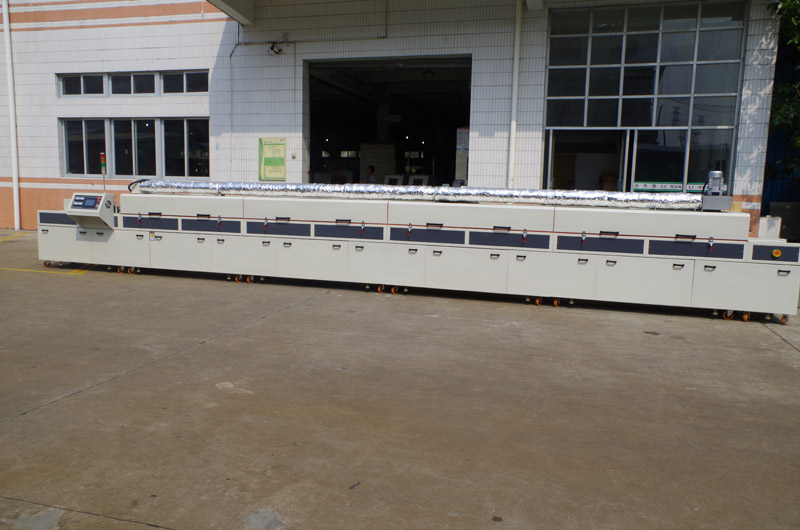
Aifuwang Equipment has received an order for tunnel furnaces from a scientific research institution in the Philippines. These tunnel furnaces showcase outstanding performance features that make them an ideal choice for scientific research applications.
Equipped with advanced infrared heating technology, Aifuwang's tunnel furnaces leverage the strong penetration ability of infrared rays. Infrared can act directly on the object being heated, heating both the interior and surface simultaneously, which significantly shortens the heating time. In practical use, compared with traditional heating methods, these furnaces can rapidly reach the set temperature (such as 200℃) within 10 - 15 minutes. This high - speed heating capability greatly improves production efficiency and meets the demands of continuous and large - scale operations, allowing materials to reach the desired processing temperature quickly, thus reducing waiting time in processes like drying electronic components or preheating plastic parts.

Fitted with a high - precision temperature control system that applies the PID intelligent temperature control algorithm, the temperature control accuracy can reach ±1℃. Multiple temperature sensors distributed inside the tunnel furnace continuously monitor the temperature at different positions. The data collected by these sensors is fed back to the control system, which then automatically adjusts the heating power based on the feedback. This mechanism ensures that the temperature inside the furnace remains uniform throughout. Even in a tunnel furnace several meters long, the temperature difference between different zones can be kept to a minimum, guaranteeing the stability of product processing quality. For example, in food baking, the uniform temperature ensures that all parts of the food are heated evenly, preventing issues like local burning or undercooking.
The infrared heating technology employed by these tunnel furnaces features a high energy conversion rate, efficiently transforming electrical energy into heat energy and minimizing energy loss. Additionally, the furnaces are constructed with high - quality thermal insulation materials, providing excellent heat retention. This effectively reduces heat dissipation and further cuts down on energy consumption. Compared with similar products, Aifuwang's tunnel furnaces can save 15% - 20% of energy. In the long run, this substantial energy saving helps enterprises significantly reduce production costs, which is particularly important for scientific research institutions that often require long - term and continuous operation of equipment.
Aifuwang's tunnel furnaces are equipped with multiple safety protection devices, including over - temperature alarms, leakage protection, and overload protection. When the internal temperature of the furnace exceeds the set safety upper limit, the over - temperature alarm system will immediately emit audible and visual alarm signals and automatically cut off the heating power supply, preventing damage to the equipment due to high temperatures and avoiding potential safety accidents. The leakage protection device can instantly cut off the power supply upon detecting any leakage, safeguarding the safety of operators. The overload protection function prevents the equipment from being damaged by long - term overloaded operation, ensuring the stable and reliable operation of the tunnel furnace. Moreover, the equipment has a fault self - diagnosis function. When a fault occurs, the system will automatically display a fault code, enabling maintenance personnel to quickly locate and troubleshoot problems, minimizing downtime during scientific research experiments.
Aifuwang's tunnel furnaces can be flexibly configured according to the diverse needs of customers. This includes customizing the length, width, and height of the tunnel furnace, the number and power of heating zones, as well as the type of conveying system. Whether for use in small - scale laboratory settings or large - scale industrial production, suitable solutions can be provided. For scientific research, where different experimental requirements may involve products of various sizes and weights, options such as mesh belt, chain, or roller conveying systems can be selected to ensure that samples are transported smoothly inside the furnace. Additionally, ventilation systems, waste gas treatment devices, and other components can be added according to specific experimental process requirements, meeting a wide range of special research needs.

 English
 中文
中文